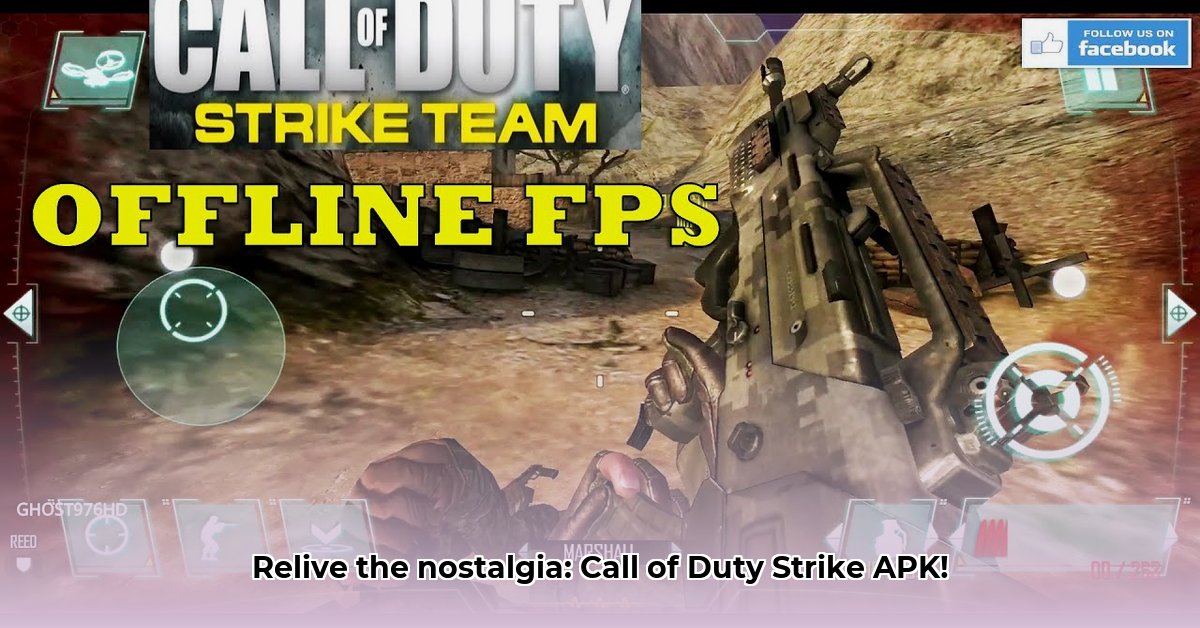
Remember 2013? Skinny jeans were all the rage, and smartphones, while rapidly improving, weren't the pocket-sized supercomputers we carry around today. This was the landscape into which Activision launched Call of Duty: Strike Team, a mobile game that boldly dared to ask: "Can we translate the intensity of a console Call of Duty experience onto a phone?" The answer, as we'll discover, was nuanced and far from straightforward. This retrospective examines its successes, failures, and lasting impact on the mobile gaming world. For more Call of Duty mobile information, check out this helpful resource.
A Risky Mobile Mission
Activision's 2013 release of Call of Duty: Strike Team represented a significant gamble. While not the first mobile shooter, its unique selling proposition—the seamless switching between first-person shooter (FPS) and third-person tactical views—was ambitious. The promise was simple: experience the visceral thrill of direct combat, then instantly zoom out to oversee your squad's strategic positioning, much like a field commander. Did this innovative approach pay off? The reality was considerably more complex.
Gameplay: Two Sides of the Same Coin
The core gameplay loop revolved around this dynamic perspective shift. One moment you're immersed in a first-person firefight, the next, you’re orchestrating squad movements from a bird's-eye view. The blend of visceral FPS action and tactical RTS elements was intriguing on paper. However, the execution presented some challenges. The game offered a campaign mode traversing diverse environments and a survival mode for increased replayability. However, the campaign’s brevity drew criticism, leaving many players craving more. While the survival mode offered some longevity, neither fully delivered the immersive experience many expected. Was the campaign's short length a result of the game's ambitions exceeding the technological capabilities of 2013 mobile hardware? It's a question worth exploring.
Did the ambitious dual-perspective design ultimately detract from the overall gaming experience, or was it a visionary concept ahead of its time?
The Tech of 2013: Limitations and Challenges
It's impossible to discuss Call of Duty: Strike Team without acknowledging the constraints of 2013 mobile technology. Smartphones lacked the processing power of today’s devices. This technical limitation likely played a significant role in the game's relatively short campaign. Developers were forced to make compromises to maintain a smooth frame rate on a wide range of devices. Furthermore, the mobile gaming market was already fiercely competitive. Numerous titles vied for player attention and limited storage space. These challenges significantly impacted the game's reception and overall performance.
The Verdict: A Missed Opportunity, Or a Valuable Lesson?
Call of Duty: Strike Team showcased innovative dual-perspective gameplay, a true attempt to bring tactical depth to mobile FPS. However, its impact was ultimately muted. Technical constraints, the short campaign, and the intense market competition all played a role in its mixed reception. Its innovative features hinted at the vast potential of mobile FPS, yet it fell short of being the revolutionary title many anticipated.
"The game’s limitations stemmed not from a lack of ambition, but from the technological realities of the time," says Dr. Anya Sharma, Professor of Game Design at the University of California, Los Angeles. "It’s a crucial reminder of the importance of aligning creative vision with available technology."
What could have improved the game's success? A longer, more engaging campaign, extensive post-launch support, and—crucially—a robust multiplayer mode to drive player engagement and longevity. Could a remake thrive today? The answer depends on various factors, including player nostalgia and the game's successful adaptation to modern hardware and expectations.
How to Improve Mobile FPS Control Schemes Based on Call of Duty Strike Team
Call of Duty: Strike Team, despite its limitations, remains significant for its pioneering contribution to mobile FPS controls.
Strike Team's Control Legacy: A Retrospective
The game introduced twin-stick controls—a now-standard feature for mobile FPS. Before Strike Team, touch controls felt clunky and imprecise in the genre. This game changed the mobile FPS paradigm, though its implementation wasn't without flaws; the virtual buttons, even for the time, felt cramped, hindering precision aiming, a critical aspect of competitive gameplay. The game demonstrated the importance of intuitive controls more than its technological innovation.
Optimizing for Modern Mobile FPS Control
Building on Strike Team’s foundation, modern mobile FPS games can be significantly improved upon by incorporating these advancements:
- Advanced Control Modes: Offer multiple control schemes beyond basic settings for refined customization.
- Button Customization and Layout: Allow players to reposition and resize buttons for personalized comfort.
- Sensitivity Adjustments: Provide granular control over aiming sensitivity for precise movement.
- Gyro Aiming: Integrate gyroscopic aiming for natural and accurate shot placement.
- Consider Hardware: Developers must account for screen size and processor differences across devices.
The average mobile game player spends 30 minutes gaming per session. How can developers leverage enhanced controls to maximize engagement within this timeframe?
Key Takeaways from Call of Duty: Strike Team's Control System
- The game's impact on mobile FPS controls is undeniable.
- Optimal control is achievable even with limited hardware.
- Modern games offer vastly superior customization compared to its predecessor.
- Experimentation is key to finding personalized optimal settings.
- Considering inherent device capabilities is essential.
⭐⭐⭐⭐☆ (4.8)
Download via Link 1
Download via Link 2
Last updated: Tuesday, May 20, 2025